
History
rgb(0,0,0)
Founded in 1876
OCAD University was founded as the Ontario School of Art in 1876 by the Ontario Society of Artists, and had 14 registered students. In 1912, we were incorporated as the Ontario College of Art (OCA), becoming Canada’s first school dedicated to educating artists. Esteemed artists such as G.A. Reid and J.E.H. MacDonald of the Group of Seven have served as presidents, and many celebrated alums have come from here.
In 1945 our curriculum was expanded and we opened our Design School; our main building at 100 McCaul Street opened in 1957. The 1960s-80s saw a period of building and growth, with the acquisition of several nearby properties. Our name changed to the Ontario College of Art & Design (OCAD) in 1996.
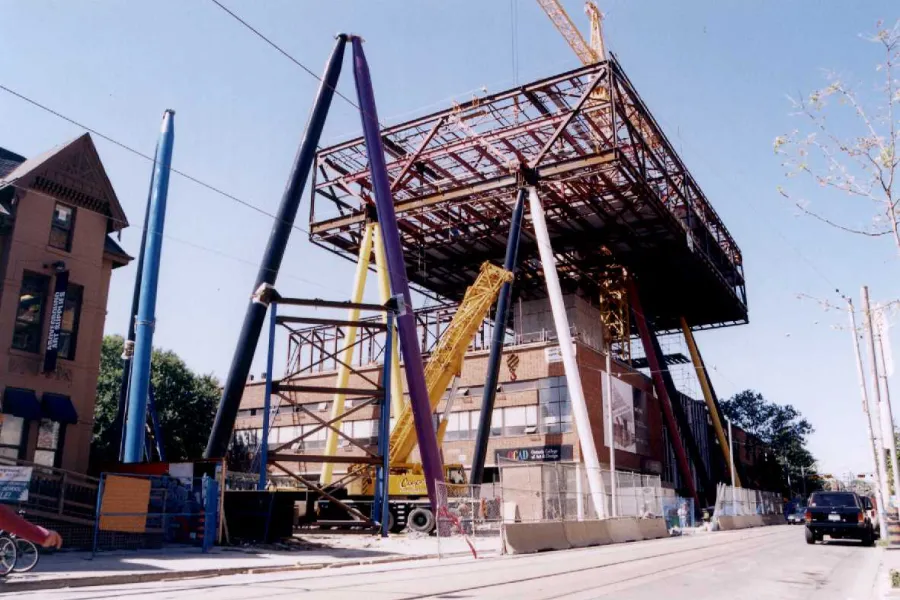
The 1990s and 2000s were marked by further expansion, beginning with the opening of two new buildings at 113 and 115 McCaul Street. Through large investments from both Ontario’s SuperBuild Program and IDEAS NEED SPACE, we opened our iconic Rosalie Sharp Centre for Design in 2004. Alum and benefactor Rosalie Sharp was named Chancellor the same year.
In 2002, we were granted university status and began to confer Bachelor of Fine Art (BFA) and Bachelor of Design (B.Des.) degrees. In 2008, we accepted our first cohort of graduate students, and began offering continuing education programs in 2009. One year later, to reflect these changes, we became OCAD University (OCAD U).
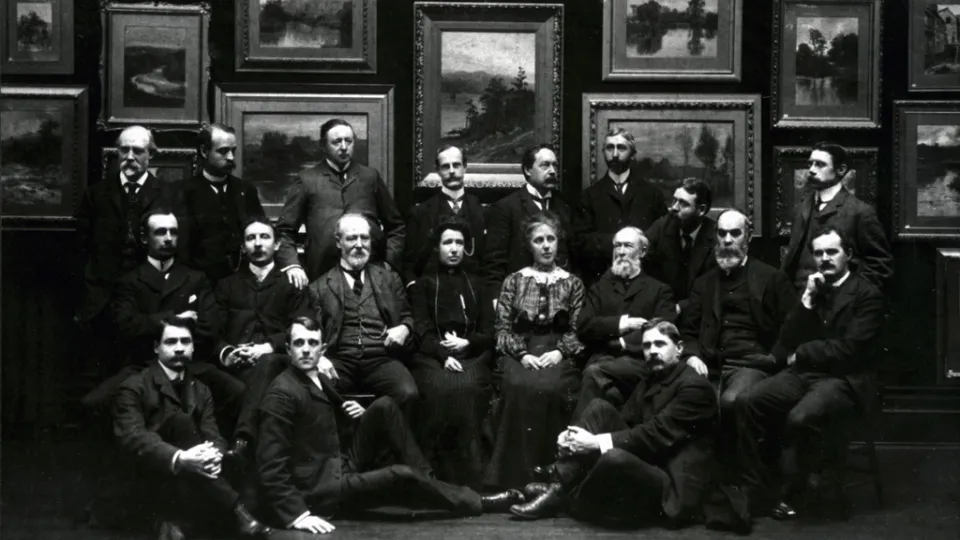
Thousands of artists and designers have passed through our doors, and as Canada’s most longstanding and respected university for art and design, we strive to be at the forefront of creative education for generations to come.
OCAD University acknowledges the ancestral and traditional territories of the Mississaugas of the Credit, the Haudenosaunee, the Anishinaabe and the Huron-Wendat, who are the original owners and custodians of the land on which we live, work and create.
rgb(255,255,255)
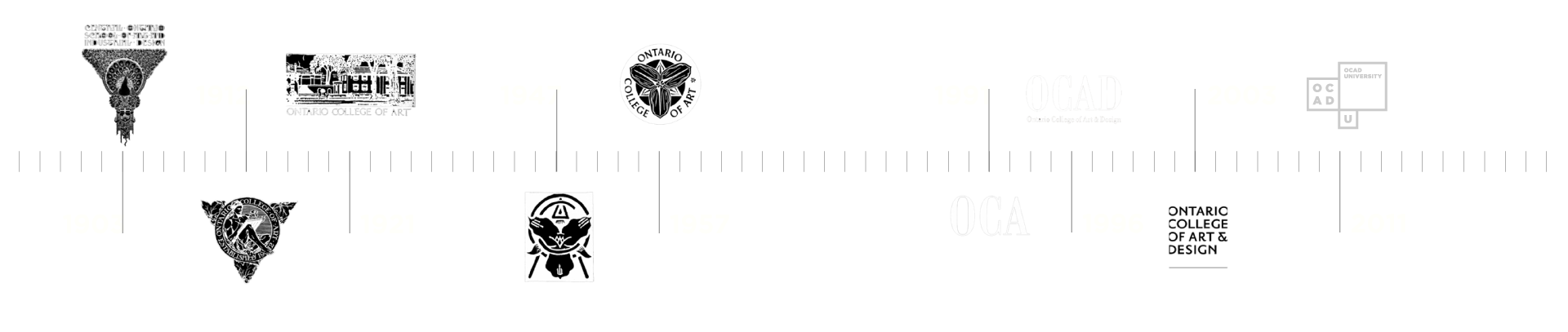
Our name
1876: we open as The Ontario School of Art at 14 King St. West, with 14 registered students
1876-1903: after various locations and name changes, our first logo was created in 1903: "Central Ontario School of Art and Industrial Design"
1912: we're renamed the Ontario College of Art (OCA) - various logo changes over the years
1996: OCA becomes the Ontario College of Art & Design (OCAD) - rebranded logo appears in 2003
2010: Ontario College of Art and Design becomes OCAD University (OCAD U) - our current logo was created in 2011

rgb(0,0,0)
rgb(0,0,0)
Leaders
OCAD U alums have shaped Canada and the world for generations. Most of the Group of Seven either studied, taught at or have been presidents of OCAD U. Filmmakers George Dunning (Yellow Submarine) and Floria Sigismondi (The Runaways, plus over 60 notable music videos) studied here. The creative directors at most of Canada’s top creative agencies are graduates. Visual artists ranging from Michael Snow (Toronto Eaton Centre’s iconic Flight Stop) to Ken Danby (The Goalie) got their start at OCAD U. More recently, Rajni Perera, Shary Boyle, Meryl McMaster and Keita Morimoto all honed their craft on our campus. Designer Don Watt (logos for Home Depot, No Name and President’s Choice) is a grad. Pulitzer Prize-winning Barry Blitt and Order of Canada recipient Anita Kunz are illustrators who have created some of history’s most iconic covers for magazines like The New Yorker, Vanity Fair and Rolling Stone.

rgb(0,0,0)
OCA Principals
1876-1878: Thomas Mower Martin, founding director
1884-1886: William Cruikshank
1912-1929: George Agnew Reid
1929-1932: J.E.H. MacDonald (acting principal in 1928; appointed principal in 1929)
1932-1951: Fred S. Haines
1951-1954: Lawrence A.C. Panton
1955-1970: Sydney Hollinger Watson
OCAD and OCAD U Presidents
1970-1971: Gene B. Butt (acting president)
1971-1972: Roy Ascott
1972-1975 Clifford Pitt
1975-1982: Paul Duncan Fleck
1983-1987: Norman Blasdell Hathaway
1987-1988: David Hall-Humperson
1988-1995: Timothy Porteous
1995-1997: Alan Barkley
1997-1998: Peter Caldwell
1998-2000: Catherine Henderson
2000-2005: Ron Shuebrook
2005-2020: Dr. Sara Diamond
2020-present: Ana Serrano
OCAD U Chancellors
2004-2007: Rosalie Sharp
2007-2012: The Hon. James K. Bartleman
2012-2017: Catherine (Kiki) Delaney
2017-2021: Salah Bachir
2022-present: Jaime Watt
rgb(0,0,0)
Timeline
rgb(0,0,0)
1870S TO 1910S: FOUNDING YEARS
1876: We open as The Ontario School of Art, founded by the Ontario Society of Artists, at 14 King St. with 14 registered students.
1882-1912: We operate out of various locations at Queen and Yonge and King St. W. and our name changes during this time.
1912: We are incorporated with a new name, Ontario College of Art (OCAD), becoming Canada’s first school dedicated to educating artists. Our logo changes over the years.
1920s to 1970s: EMERGING AS CANADA’S LEADING ART AND DESIGN SCHOOL
1920: Canadian painter George Agnew Reid becomes first OCA principal of OCA. Arthur Lismer, from the Group of Sevent, is vice-principal until 1927.
1921: We’ve grown to 330 students and 16 instructors and buy our first building at Grange Park, designed by George Agnew Reid.
1945: We expand our program to include design by opening our School of Design.
1951: OCA Student Council is founded.
1957: We open our new building to welcome students at 100 McCaul St.
1963-1967: We open the Nora E. Vaughn Auditorium and add two new floors and an atrium at 100 McCaul St.
1976: We launch our Alumni Association.
rgb(0,0,0)
1990s to 2026: BECOMING A UNIVERSITY, RESPONSIVE TO STUDENT NEEDS
1996: Our name changes to the Ontario College of Art & Design (OCAD) and a rebranded logo appears in 2003. We restructure and create three Faculties: Foundation (first-year), Art and Design.
1998: We open two new buildings at 113 and 115 McCaul St.
1998: We open our Integrated Media production studios.
2000: We receive a $24-million investment from Ontario’s Superbuild Program and our IDEAS NEED SPACE capital campaign raises $14 million for building expansion.
2000: Alsop Architects and Robbie, Young + Wright begin work on a new centre for design.
2001: We receive a $5 million donation from alum Rosalie Sharp and her husband, Isadore Sharp.
2002: We are granted university status by the Government of Ontario. We begin to confer Bachelor of Fine Art (BFA) and Bachelor of Design (B.Des.) degrees.
2002: We hold a groundbreaking ceremony for the Rosalie Sharp Centre for Design.
2004: We open the iconic Rosalie Sharp Centre for Design, known as “the tabletop,” designed by Will Alsop. The building is named after alum and benefactor Rosalie Sharp.
2004: Rosalie Sharp becomes the University’s first chancellor.
2005: We receive a $2.5 million grant from Nancy Young.
2007: The OCAD Professional Gallery opens and changes its name to Onsite Gallery in 2011.
2007: We acquire the historic New Textile Building at 205 Richmond St. W., which now houses our graduate programs and several research labs and studios.
2008: We accept our first cohort of graduate students.
2009: We launch the Indigenous Visual Culture program.
2009: We launch the School of Continuing Studies programs.
2010: Our name changes to OCAD University, Canada’s oldest and largest art and design school. Our current logo is created in 2011.
2011: Our Digital Futures program welcomes its first student cohort.
2012: The Inclusive Design Research Centre opens; a year later we launch the Master in Inclusive Design.
2012: We launch Digital Painting and Expanded Animation programs.
2013: We establish the RBC Centre for Emerging Artists & Designers to support students and recent graduates advance their careers.
2014: Rosalie and Isadore Sharp pledge $3 million and The Delaney Family Foundation pledges $2 million.
2014: We receive a $3 million donation from Ada Slaight.
2015: Dr. Gerald McMaster becomes the University’s first Canada Research Chair, Tier 1, in Indigenous Visual Culture and Curatorial Practice. We’ve since had three more Canada Research Chairs.
2015: GradEx draws more than 40,000 visitors celebrating OCAD U’s 100th graduate exhibition.
2017: Onsite Gallery officially opens its new professional space, a 4,500-square-foot venue at 199 Richmond St. W.
2018: We open our Waterfront Campus, home of OCAD U CO.
2019: We launch the Creative Writing program.
2020: We offically open the refurbished Fabrication Centre, the University’s wood, metal, plastics and rapid prototyping studios.
2020: We launch OCAD U LiVE, our 24/7 on-demand digital streaming channel.
2020: In March, with the announcement of a global pandemic, we close our campus and suspend all classes. We pivot quickly to transition all courses from in-person to remote delivery so students could complete the school year.
2020: In June, the Government of Ontario gives us the full power to confer our own degrees, including honorary doctorate degrees.
2020-21: Our programs are delivered remotely and we develop resources to support our faculty in redesigning their courses within this new reality.
2021-22: We return to in-person classes and events.
2021: We adopt facility design standards for all construction and renovation projects.
2021: We gather as a community to recognize the inaugural National Day for Truth and Reconciliation on September 30 and continue this recognition annually.
2021: We celebrate the launch of the Centre for the Study of Black Canadian Diaspora, established by OCAD U Associate Professor Dr. Andrea Fatona.
2021: We sign the Scarborough Charter on Anti-Racism and Black Inclusion in Canadian Higher Education, along with 40 Canadian universities.
2022-23: We launch the Experimental Animation program and introduced a new Science Minor program.
2022-23: We are recognized as a Center for Sustainability Across the Curriculum by the Association for the Advancement of Sustainability in Higher education becoming the first Canadian university to participate in this association.
2023: We launch our new six-year Academic and Strategic Plan, which includes a new vision: OCAD U is a vibrant community of bold, curious and compassionate artists, designers and scholars imagining and creating a joyful, equitable and sustainable world.
2023: We launch the new research centre, Global Centre for Climate Action.
2023: We receive a $2.5 million gift from The Delaney Family Foundation to support Onsite Gallery, and establish The Delaney Family Emerging Curator’s Prize and The Delaney Family Bursary Fund.
2023-24: We announce the new undergraduate minor, Black Studies Design and Art, making us the first Association of Independent Colleges of Art and Design (AICAD) school in Canada to offer this program.
2023-24: We receive $1 million from the RBC Foundation, a renewed commitment to fund our RBC Centre for Emerging Artists and Designers.
2023-24: We earn our first-ever STARS Silver rating from the Association for the Advancement of Sustainability in Her Education.
2023-24: We launch the Cultural Policy Hub at OCAD U, a pan-Canadian, bilingual network supporting cultural policy development and decision-making, from local to national levels.
2024: Senate approves a five-year Sustainability Curriculum Strategy.
2025: We launch the National Network of Canadian Art and Design Universities to support advocacy efforts for shared sector priorities.
2025: We create an advisory group to address the many aspects and impacts of Generative Artificial Intelligence and release a statement on the use of Generative AI.
2025: We host our inaugural Gala and After Party, a sold-out event with more than 250 guests, raising $385,00 to support student bursaries.
2025: At the June Convocation ceremonies, we celebrate the largest graduating class in recent history with 1,086 graduates.
2025: We celebrate the opening of the revitalized Butterfield Park, funded by contributions from George and Martha Butterfield, David Binet and Chancellor Jaime Watt and Paul Ferguson.
2025: We receive gifts from David Binet totalling $1 million, including the David Binet Leadership Fund.
2025: We move to become a carbon-neutral campus with the release of a multi-year decarbonization plan.
rgb(0,0,0)